Practice VMware 3V0-24.25 Exam Pdf & 3V0-24.25 PDF Question
Wiki Article
DOWNLOAD the newest Getcertkey 3V0-24.25 copyright from Cloud Storage for free: https://drive.google.com/open?id=1immn1ISyyyA-5yYgKJm80E6QK63lVwlR
We are a group of IT experts and certified trainers who write VMware vce dumps based on the real questions. Besides, our 3V0-24.25 exam dumps are always checked to update to ensure the process of preparation smoothly. You can try our 3V0-24.25 Free Download study materials before you purchase. Please feel free to contact us if you have any questions about the 3V0-24.25 pass guide.
VMware 3V0-24.25 Exam Syllabus Topics:
| Topic | Details |
|---|---|
| Topic 1 |
|
| Topic 2 |
|
| Topic 3 |
|
| Topic 4 |
|
| Topic 5 |
|
>> Practice VMware 3V0-24.25 Exam Pdf <<
Quiz 2026 3V0-24.25: Advanced VMware Cloud Foundation 9.0 vSphere Kubernetes Service Newest Practice Exam Pdf
You only need 20-30 hours to practice our software materials and then you can attend the exam. It costs you little time and energy. The 3V0-24.25 exam questions are easy to be mastered and simplified the content of important information. The Advanced VMware Cloud Foundation 9.0 vSphere Kubernetes Service test guide conveys more important information with amount of answers and questions, thus the learning for the examinee is easy and highly efficient. The language which is easy to be understood and simple, 3V0-24.25 Exam Questions are suitable for any learners no matter he or she is a student or the person who have worked for many years with profound experiences. So it is convenient for the learners to master the 3V0-24.25 guide torrent and copyright in a short time. The amount of the examinee is large.
VMware Advanced VMware Cloud Foundation 9.0 vSphere Kubernetes Service Sample Questions (Q22-Q27):
NEW QUESTION # 22
A VMware Administrator is tasked with implementing a backup and restore strategy using Velero and external object storage for the namespace 'myapp1. Arrange the steps In the correct order of operations to enable Vetero.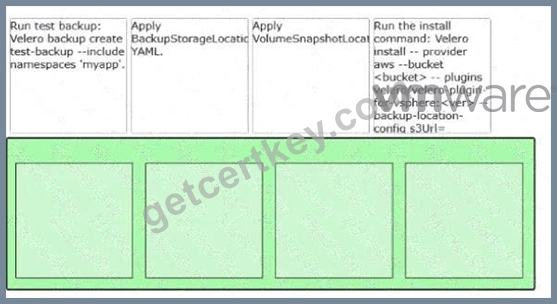
Answer:
Explanation: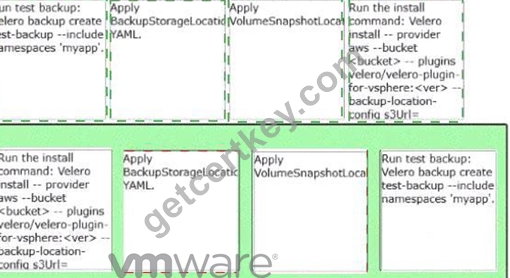
Explanation:
Answer (Correct Order):
* Run the install command:velero install ... --provider aws --bucket <bucket> ... --plugins ... --backup- location-config ...
* Apply BackupStorageLocation YAML.
* Apply VolumeSnapshotLocation YAML.
* Run test backup:velero backup create test-backup --include-namespaces "myapp1" The correct sequence follows Velero's operational model: install the Velero components first, then define where backups and snapshots are stored, and finally validate with a real backup. In VCF 9.0, the Velero Plugin for vSphere installation command includes parameters for the object-store provider, bucket, and plugin images, which establishes the Velero control plane in the target namespace and prepares it to communicate with an S3-compatible store.
After the installation is in place, you apply theBackupStorageLocationconfiguration so Velero has a durable destination for Kubernetes backup metadata in the object store. This aligns with the VCF 9.0 guidance that backups upload Kubernetes metadata to the object store and require S3-compatible storage for backup/restore workflows.
Next, apply theVolumeSnapshotLocationso Velero knows how and where to create/track volume snapshots for stateful workloads. The VCF 9.0 install example explicitly includes snapshot/backup location configuration parameters, reflecting that both must be set for complete protection.
Finally, run a test backup scoped to the namespace (--include-namespaces=my-namespace) to confirm end-to- end functionality.
NEW QUESTION # 23
A VKS Administrator manages a fleet of TKG clusters running the tanzu-standard package repository version v1.6.0. A critical CVE has been identified in the installed version of Fluent Bit, which is resolved in package repository version v2.0.0.
What is the correct procedure to update the available packages on a target cluster to the new version?
(Choose 2.)
- A. Update the vSphere Supervisor version; package repositories are immutable and tied strictly to the Supervisor release.
- B. Manually uninstall the old Fluent Bit package and reinstall it using helm install from a local chart.
- C. Wait for the kapp-controller to reconcile the change. Once the repository status is ReconcileSucceeded, the new package versions (e.g., Fluent Bit 2.x) will be listed in kubectl get packages.
- D. Delete the PackageRepository object and recreate it with the same name but the new URL; this will automatically upgrade all installed packages immediately.
- E. Use kubectl to update the PackageRepository CR named tanzu-standard in the cluster, changing the spec.fetch.imgpkgBundle.image tag to the new version (v2.0.0).
Answer: C,E
NEW QUESTION # 24
Refer to the exhibit in the following StorageClass manifest, which field is used to specify the Volume Plugin driver used for the underlying storage array?
YAML
apiVersion: storage.k8s.io/v1
kind: StorageClass
metadata:
name: standard
provisioner: kubernetes.io/aws-ebs
parameters:
type: gp2
reclaimPolicy: Retain
allowVolumeExpansion: true
mountOptions:
- debug
volumeBindingMode: Immediate
- A. name
- B. provisioner
- C. type
- D. parameters
Answer: B
Explanation:
In a Kubernetes-based architecture like the vSphere Kubernetes Service (VKS) within VMware Cloud Foundation (VCF) 9.0, a StorageClass manifest serves as the definition for dynamic volume provisioning. The provisioner field is the mandatory attribute that determines which specific volume plugin or driver is invoked to create the underlying storage resource. In the provided exhibit, the string provisioner: kubernetes.io/aws- ebs specifies that the AWS Elastic Block Store (EBS) driver is the orchestrator for the lifecycle of the volumes associated with this class.
In a standard on-premises VCF 9.0 deployment, the provisioner field typically points to csi.vsphere.vmware.
com, identifying the vSphere Container Storage Interface (CSI) driver. This driver acts as the translator between Kubernetes PersistentVolumeClaims (PVCs) and vSphere's Cloud Native Storage (CNS) layer. The other fields in the manifest serve supporting roles: name provides a reference for the StorageClass, parameters (such as type: gp2) pass configuration-specific details to the driver, and reclaimPolicy determines what happens to the data once a claim is deleted. However, only the provisioner field defines the " who " of the operation-the actual software driver responsible for communicating with the storage array or cloud provider to provision the physical or virtual disk. Understanding this distinction is critical for administrators managing hybrid-cloud workloads where different provisioners are used across diverse infrastructure backends.
NEW QUESTION # 25
What role does Contour play in a VMware vSphere Kubernetes Service (VKS) architecture?
- A. Contour provides encryption services for pod to pod network traffic.
- B. Contour provides egress management at the application layer.
- C. Contour provides ingress management at the application layer.
- D. Contour provides load balancing for ingress traffic.
Answer: C
Explanation:
Contour is a high-performance Ingress controller for Kubernetes that serves as the control plane for the Envoy edge and service proxy. Within the VMware Cloud Foundation (VCF) 9.0 and vSphere Kubernetes Service (VKS) architecture, Contour is a critical component used to manage how external traffic reaches services running inside a cluster. It functions specifically at the application layer (Layer 7 of the OSI model), enabling sophisticated routing based on HTTP paths, hostnames, and headers.
By utilizing the Envoy proxy, Contour provides a scalable and maintainable way to handle standard Kubernetes Ingress resources as well as the more advanced HTTPProxy custom resource definitions (CRDs).
In a VKS environment, once the Supervisor is configured and a workload cluster is deployed, Contour is typically installed as a managed package to provide ingress services. It handles essential tasks such as SSL
/TLS termination, which offloads the encryption overhead from individual application pods, and supports advanced traffic management patterns like canary deployments or blue-green updates. Unlike traditional load balancers that may operate only at Layer 4, Contour's deep integration with the Kubernetes API allows it to dynamically update routing rules as pods scale or fail, ensuring high availability and fine-grained control for containerized applications. This makes it the standard solution for application-layer ingress management across the VMware Tanzu and VKS ecosystem.
NEW QUESTION # 26
A cloud operations team is managing multiple Supervisor Clusters across two regions. Each region hosts its own vSphere Kubernetes clusters, integrated through a federated service mesh to enable consistent service connectivity and policy enforcement across environments.
The application team wants to expose a multi-tier microservice named "GovApp", which includes front-end, API, and database services distributed between the two regions. Uniform traffic routing, identity, and security policies are also needed for these workloads regardless of the cluster or region in which they are deployed.
To meet these requirements, the architects decide to create a Global Namespace that spans both Supervisor Clusters.
Which two statements describe the requirements for a Global Namespace in a vSphere Kubernetes Service Mesh deployment? (Choose two.)
- A. Provides centralized logging for Service Mesh traffic.
- B. Provides distributed Ingress and egress services to support multiple namespaces across multiple clusters.
- C. Applies a single policy to multiple namespaces across multiple clusters.
- D. Defines an application boundary across multiple clusters.
- E. Enables automatic placement of workloads to any global cluster based on traffic demand.
Answer: C,D
Explanation:
A Global Namespace in a service-mesh-driven, multi-cluster design is fundamentally anorganizational and policy boundarythat lets platform teams treat multiple Kubernetes namespaces-across multiple clusters
/regions-as one logical application domain. That is whyBis correct: it defines an application boundary spanning clusters, which is exactly what "GovApp" needs when its tiers are distributed across regions but must still behave as one application. It also explains whyAis correct: the value of a Global Namespace is that you can applyconsistent identity, security, and traffic policiesacross all member namespaces and clusters, rather than configuring them separately per cluster. This supports uniform mTLS/authorization posture, consistent service-to-service access rules, and standardized routing behaviors regardless of where a service instance runs.
The other options describe outcomes that may be enabled by additional service-mesh features, but they are not the corerequirementsthat define a Global Namespace: distributed ingress/egress is not guaranteed simply by the namespace construct, automatic workload placement is typically handled by schedulers/placement engines rather than the namespace boundary, and centralized logging is an observability capability outside the namespace requirement itself.
NEW QUESTION # 27
......
To help you pass 3V0-24.25 exam is recognition of our best efforts. In order to achieve this goal, we constantly improve our 3V0-24.25 exam materials, allowing you to rest assured to use our dumps. If you have any question about our products and services, you can contact our online support in our Getcertkey website, and you can also contact us by email after your purchase. If there is any update of 3V0-24.25 software, we will notify you by mail.
3V0-24.25 PDF Question: https://www.getcertkey.com/3V0-24.25_braindumps.html
- 3V0-24.25 High Passing Score ???? 3V0-24.25 Latest Dumps ???? 3V0-24.25 Dumps ???? Download 「 3V0-24.25 」 for free by simply entering ▛ www.dumpsmaterials.com ▟ website ????Exam 3V0-24.25 Papers
- Free PDF VMware 3V0-24.25 - Advanced VMware Cloud Foundation 9.0 vSphere Kubernetes Service Perfect Practice Exam Pdf ???? Go to website ➥ www.pdfvce.com ???? open and search for 「 3V0-24.25 」 to download for free ????3V0-24.25 Latest Test Question
- Authorized Practice 3V0-24.25 Exam Pdf - Leader in Qualification Exams - Useful 3V0-24.25 PDF Question ???? Download 【 3V0-24.25 】 for free by simply searching on ⏩ www.prep4sures.top ⏪ ????3V0-24.25 Top Dumps
- Certification 3V0-24.25 Dumps ???? 3V0-24.25 Pass Test Guide ???? 3V0-24.25 Latest Dumps ???? Open website ☀ www.pdfvce.com ️☀️ and search for ➥ 3V0-24.25 ???? for free download ????3V0-24.25 Reliable Torrent
- 3V0-24.25 Reliable Torrent ???? 3V0-24.25 Valid Test Topics ???? 3V0-24.25 Latest Dumps ???? Enter 《 www.practicevce.com 》 and search for ( 3V0-24.25 ) to download for free ????3V0-24.25 Latest Test Question
- Pass Guaranteed Valid VMware - 3V0-24.25 - Practice Advanced VMware Cloud Foundation 9.0 vSphere Kubernetes Service Exam Pdf ???? Enter ➠ www.pdfvce.com ???? and search for ➽ 3V0-24.25 ???? to download for free ????Certification 3V0-24.25 Dumps
- Accurate 3V0-24.25 Practice Engine gives you high-effective Exam Quiz - www.vceengine.com ???? Go to website 《 www.vceengine.com 》 open and search for ➤ 3V0-24.25 ⮘ to download for free ????Reliable 3V0-24.25 Exam Simulator
- Practice 3V0-24.25 Exam Fee ???? 3V0-24.25 Top Dumps ???? 3V0-24.25 Pass Test Guide ⬜ Search for ( 3V0-24.25 ) and download it for free immediately on 【 www.pdfvce.com 】 ????3V0-24.25 Latest Test Question
- Experience the Real Time VMware 3V0-24.25 Exam Environment ???? { www.examcollectionpass.com } is best website to obtain 《 3V0-24.25 》 for free download ????Certification 3V0-24.25 Dumps
- 3V0-24.25 Valid Test Topics ???? Reliable 3V0-24.25 Test Guide ???? 3V0-24.25 Valid Torrent ???? Download { 3V0-24.25 } for free by simply entering ⇛ www.pdfvce.com ⇚ website ????3V0-24.25 Training Materials
- 3V0-24.25 Dumps ???? Reliable 3V0-24.25 Exam Simulator ???? 3V0-24.25 Training Materials ⏰ Download 「 3V0-24.25 」 for free by simply searching on ✔ www.practicevce.com ️✔️ ????Practice 3V0-24.25 Exam Fee
- anitafidb849229.blogdemls.com, bookmarkgenius.com, www.stes.tyc.edu.tw, www.stes.tyc.edu.tw, larissabrlp428698.blog4youth.com, tiffanykzvd805911.blazingblog.com, margielykm842737.blogchaat.com, www.stes.tyc.edu.tw, sairavogd016196.loginblogin.com, rafaellkkk352199.muzwiki.com, Disposable vapes
BTW, DOWNLOAD part of Getcertkey 3V0-24.25 dumps from Cloud Storage: https://drive.google.com/open?id=1immn1ISyyyA-5yYgKJm80E6QK63lVwlR
Report this wiki page